
Is H4 LEDr legal under UN R37 today? The short answer is no, not as a generally approved H4 LED replacement category. Our review of the official UNECE framework on 22 July 2026 found no in-force UN R37 H4 LEDr category sheet. A national approval tied to a vehicle positive list may cover a specific H4 product and specific vehicles, but that is a different approval route. Socket fit, an E-mark, or a supplier’s word “legal” does not close that gap.
Last reviewed: 22 July 2026. Review trigger: a formal H4 category proposal, GRE or WP.29 adoption, or a new H4 LEDr category sheet in the applicable UNECE category system.
What is the short answer on H4 LEDr legality?
There is no evidence in the reviewed official material that ordinary H4 LED bulbs can be treated as a universal UN R37 LEDr replacement. The current consolidated UN Regulation No. 37 text provides the approval framework for filament light sources and their LED replacement counterparts, but an H4 product still needs an applicable category and approval route. A GRE working document (GRE-94-18, informal, April 2026) lists H4 among the categories still under investigation. The regulation is part of the UNECE framework, not an EU-only regulation.
A national positive-list approval can produce a narrower answer. It may authorize a named product for listed vehicle and lamp combinations after the applicable national process. It does not create an H4 LEDr category under UN R37, and it must not be extended to vehicles absent from that list. Buyers therefore need to ask which approval mechanism supports the claim before asking whether the bulb fits.
Why is dual-beam LED replacement harder?
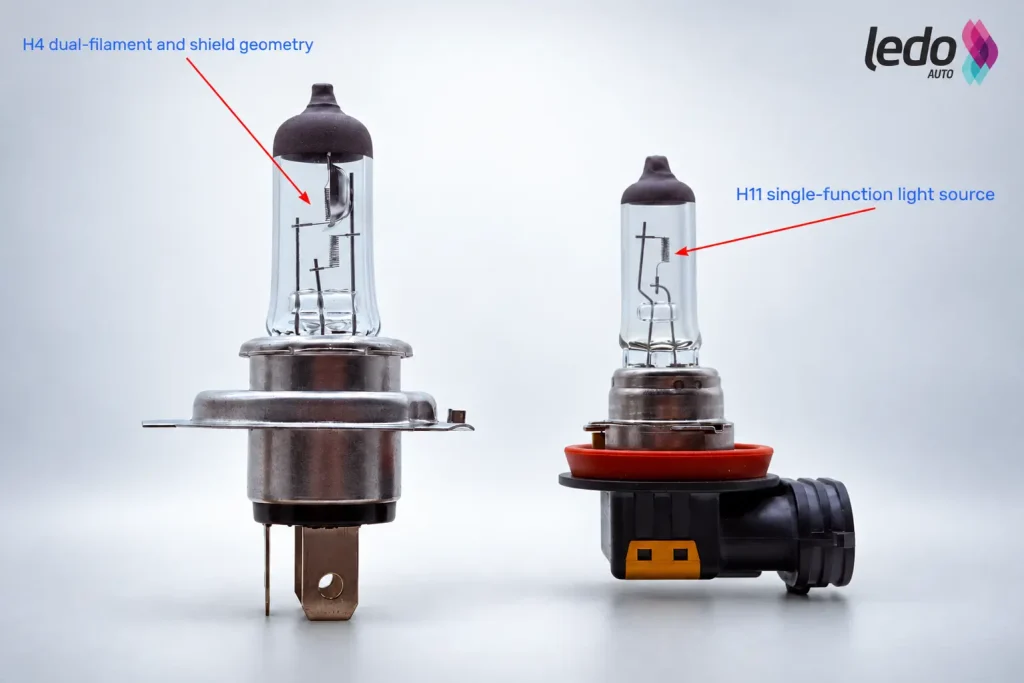
An H4 halogen light source combines low beam and high beam functions in one bulb. The lamp was designed around two filament positions and a shielding arrangement. Each filament occupies a different reference position, so the reflector or lens receives light from a different region when the driver changes functions.
The low beam depends on more than total lumen output. The filament position and the shield help control which rays reach the optical system and which are blocked. Small changes in the emitting area’s location, length, width, or orientation can move light across the cutoff. A replacement may appear bright near a wall while sending too much light above the intended boundary or leaving useful areas underlit.
The high beam uses the same lamp but asks the second emitting region to feed a different distribution. An H4 dual beam LED replacement must therefore reproduce two optical reference regions inside one package. It must also preserve the shielding effect for low beam. Moving an LED chip closer to one ideal filament location can make the other function worse. Adding a large heat sink or driver may solve a thermal problem but create a cap, cover, installation, or orientation problem.
H11 is a narrower comparison because it is a single-function category. That does not make every H11 LED bulb compliant, but it removes the need to recreate two filament functions and one shield relationship in the same source. The distinction explains why “same base” is weak evidence for H4. An H4 P43t base can locate the product mechanically without proving that both far-field beam patterns remain within the required limits.
What does the regulatory explanation prove?
UN R37 homologation is a light-source approval route. A conforming LEDr category needs defined technical requirements and an applicable category sheet. Those requirements do more than describe a cap. They address the characteristics needed for the LED replacement to act as the counterpart light source in approved lamps. The UNECE equivalence criteria show why geometry, photometry, electrical behavior, thermal behavior, and technology-specific controls need separate treatment.
H4’s original filament construction gives engineers two functions to reproduce. The approval question is not whether an LED package can emit low beam and high beam light. It is whether a standardized H4 LEDr design can meet the applicable requirements and preserve lamp performance across its authorized scope. The reviewed sources do not provide a publishable basis for claiming that this step has been completed for H4.
An E-mark must be read in context. The approval number should identify the regulation and approved type. R10 concerns electromagnetic compatibility. Neither an unexplained E-mark nor R10 alone proves UN R37 H4 LEDr homologation or road-use permission.
What is the current status, what may be allowed, and what is not proven?
The table separates the category routes reviewed on 22 July 2026. It does not replace a product certificate or a destination-market check.
|
Category |
Status |
Effective date |
Source |
|---|---|---|---|
|
H4 |
No in-force UN R37 H4 LEDr category sheet found; listed among categories under investigation. A national positive-list approval may cover a specific product and listed vehicles |
No UN effective date |
GRE-94-18 (informal, Apr 2026); UN R37 consolidated text |
|
H11 |
Established UN R37 LEDr category route; each product still needs matching approval evidence and must remain within its conditions |
Verify against the applicable category sheet and approval document |
For the full and current list of approved LEDr categories, see the approved LED bulb categories page.
A vehicle-specific national approval may permit an H4 LED product where the named product, vehicle, lamp, installation conditions, and market all match the approval or positive list. Buyers should obtain the approval document and current vehicle list from the responsible approval route. A listing for one vehicle cannot support a claim covering every H4 lamp.
The current evidence does not prove a universal H4 LEDr approval, general interchangeability, or road legality based only on a P43t-compatible base. It also does not prove that every H4 LED product is unsafe or prohibited in every jurisdiction. Those broader conclusions would exceed the reviewed sources. The defensible statement is narrower: H4 lacks an in-force UN R37 LEDr category in the material reviewed, while separate national mechanisms may create limited vehicle-specific permissions.
What does this mean for distributors and stores?
Treat “H4 LED legal” as an evidence request, not a product feature. Ask the supplier to name the regulation, approval authority, certificate holder, product type, exact bulb marking, authorized vehicles, and market. Match those details to the physical sample and packaging. If the answer is only an E-mark photo, an EMC report, or a broad compatibility list, the road-use claim remains unsupported.
Avoid packaging that says “road legal in Europe” without the applicable conditions. Europe is not one undifferentiated approval scope, and UN R37 is not limited to the EU. Sales staff should distinguish physical fit, national vehicle-list permission, UN type approval, and local road-use rules. That wording protects the buyer from ordering stock that cannot support the intended claim.
Why may H11 be the practical route first?
For a current UN R37 LEDr program, H11 offers a clearer starting point. Read the H11 approval explanation, then use the H11 certificate verification guide to compare the certificate holder, category, product type, approval code, and sample marking. The H11, H7 and H4 comparison helps teams separate a current category route from a monitored opportunity.
Buyers can review the ECE R37 H11 LEDr product page. H4 buyers should subscribe to H7 and H4 regulatory updates and use the Buyer Checklist before accepting a legality claim.
Frequently asked questions
By Jack Liu – Co-founder & Product Director, LEDOAUTO.
Regulatory review: LEDOAUTO Engineering Team – verified against official UNECE documents. Last reviewed: 22 July 2026.