
123EB combines a smaller package, a visible metal retaining spring and a thinner dual-sided emitting structure. In this test, it also records higher right-side and peak illuminance, a slightly lower B50L value and a lower emitting-area surface temperature after 30 minutes.
Compared samples: one EB H11 LEDr lamp and one Luxfighter P36-H11 LEDr lamp. This comparison uses the photographs and measurements from the EB H11 LEDr review and Luxfighter H11 LEDr review.
Test conditions
Both lamps operated at 13.2 V in a 26°C environment. Illuminance was recorded at the same E-Mark panel points from 3.5 m after a 30-minute warm-up. Emitting-area surface temperature was recorded after 30 minutes, and fan noise was measured from 3.5 cm.
Key Comparison Points
- Packaging: EB takes up less external volume; Luxfighter has the lighter empty package.
- Lamp construction: both use fan-assisted cooling and external drivers. EB has a metal retaining spring; none is visible on the reviewed Luxfighter base.
- Emitting geometry: both have a rectangular phosphor window. The distance between opposing emitting surfaces is 1.154 mm for EB and 2.468 mm for Luxfighter.
- Box system: EB covers the B subdivisions more fully and keeps the D region dark. Luxfighter’s emitting band extends above the upper reference boundary, with visible illumination on surrounding surfaces.
- Beam and illuminance: EB is higher at 25R, 50R, 75R and EMAX and slightly lower at B50L. Luxfighter is higher at the centre-left points.
- Temperature and noise: After 30 minutes, EB was 42.7°C cooler than Luxfighter, while its noise level measured at 3.5 cm was 3.3 dBA lower.
1. Packaging Section
Package dimensions and empty-box weight show how much space and transport weight the packaging adds to bulk orders.
Package and included contents
The front views compare the heat-sink, cable and external-driver designs.
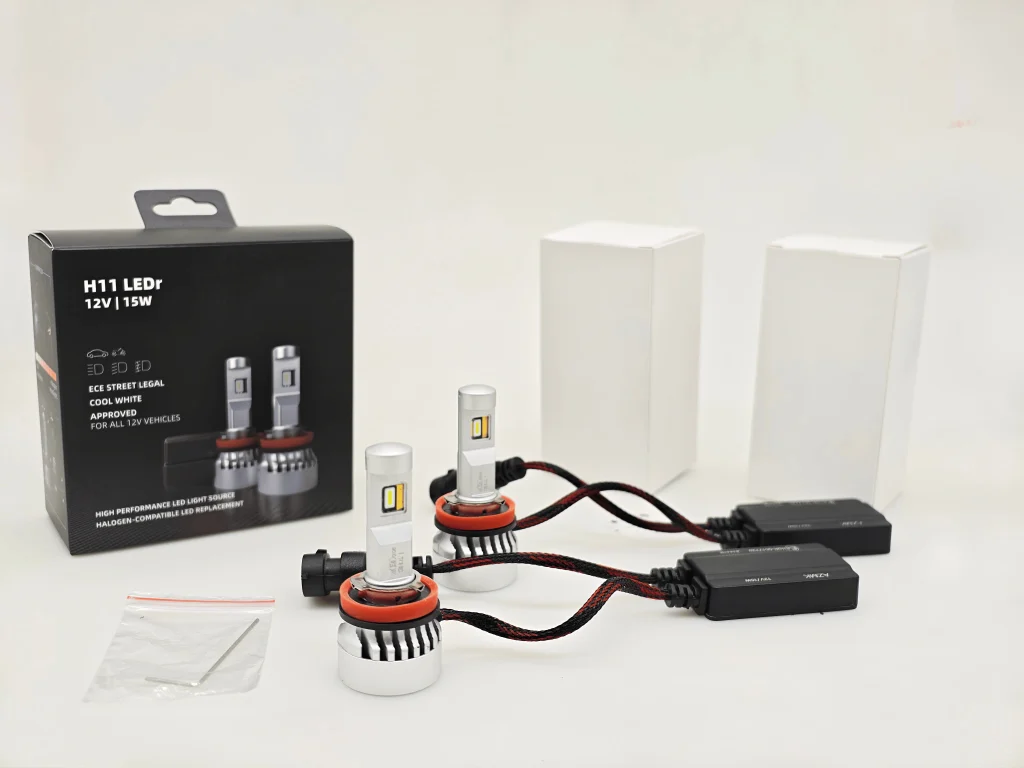
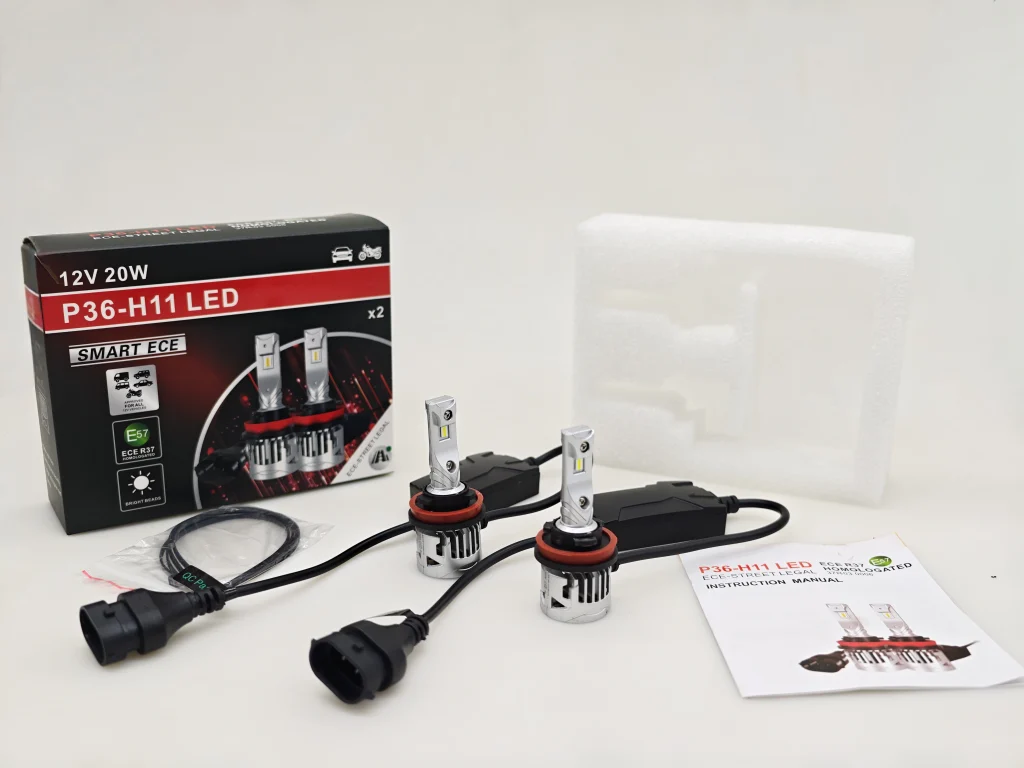
EB is shown with two lamps, two external drivers, two plain inner boxes and an accessory bag. Luxfighter includes two lamps with driver modules and H11 leads, foam support, a cable tie and printed instructions.
External package dimensions
Smaller external volume can reduce the space required for stock and support denser carton packing, depending on carton layout.
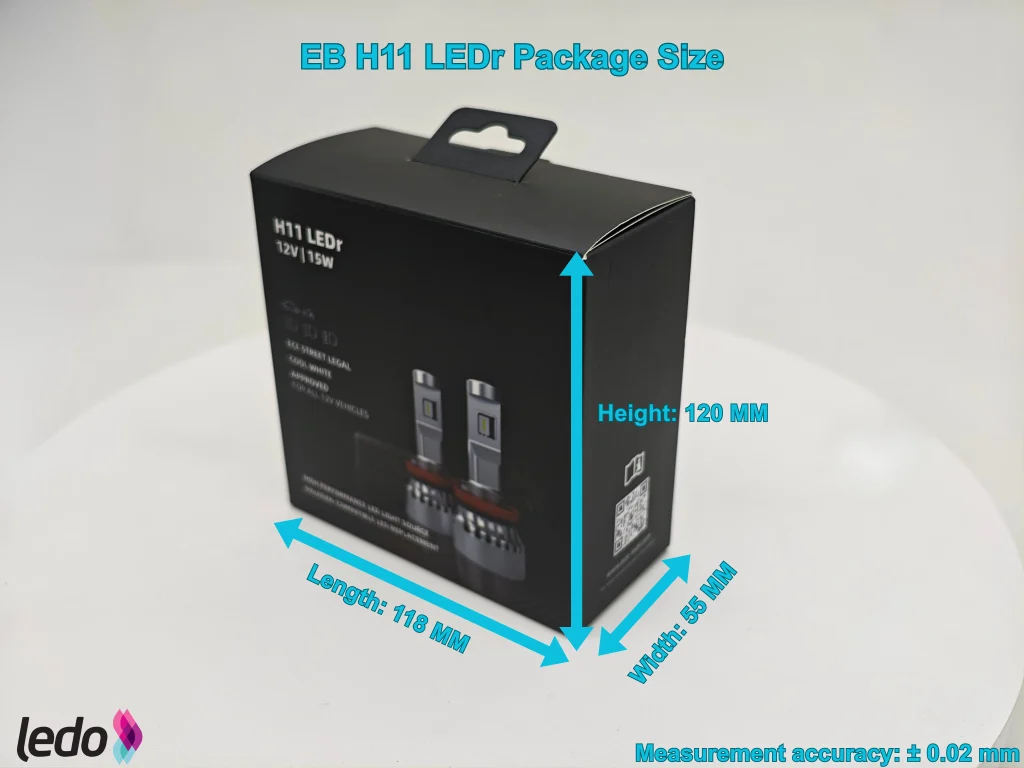
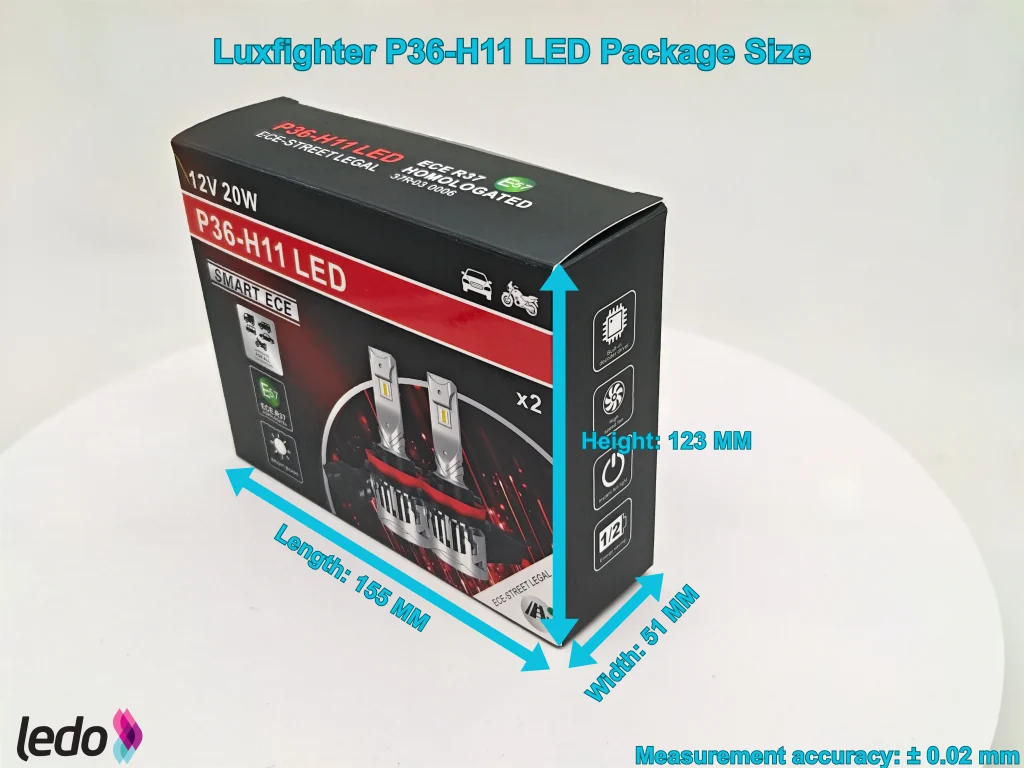
EB measures 118 × 55 × 120 mm, approximately 0.779 L. Luxfighter measures 155 × 51 × 123 mm, approximately 0.972 L. EB’s nominal external volume is 19.90% smaller than Luxfighter’s.
Empty-package weight
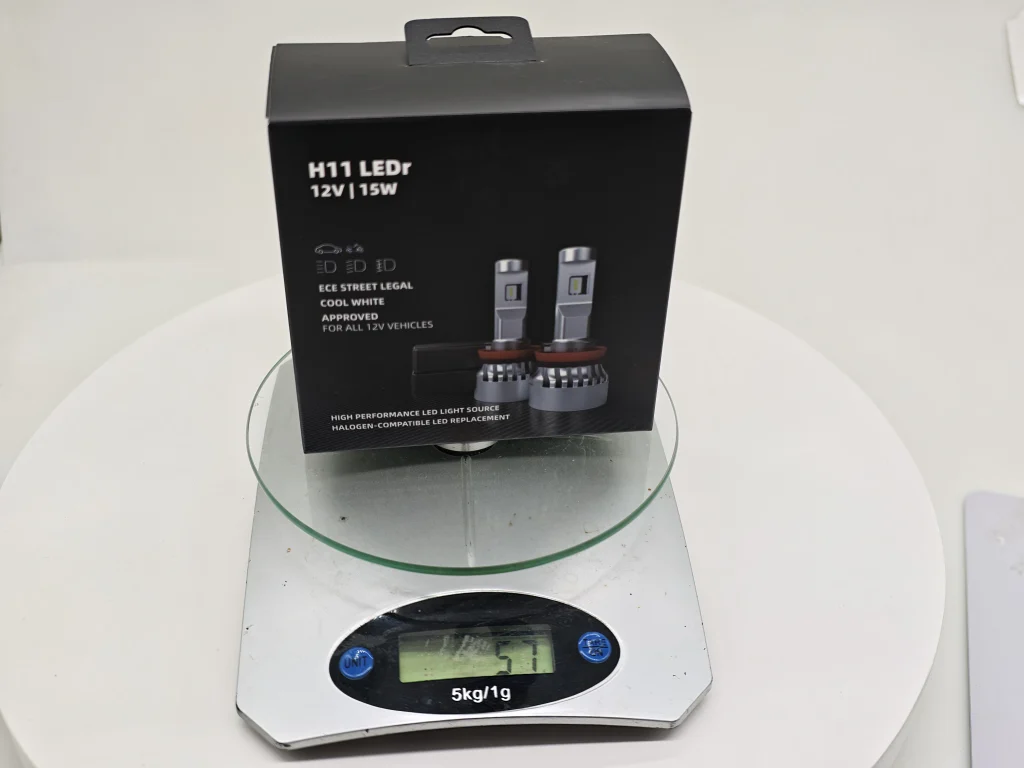
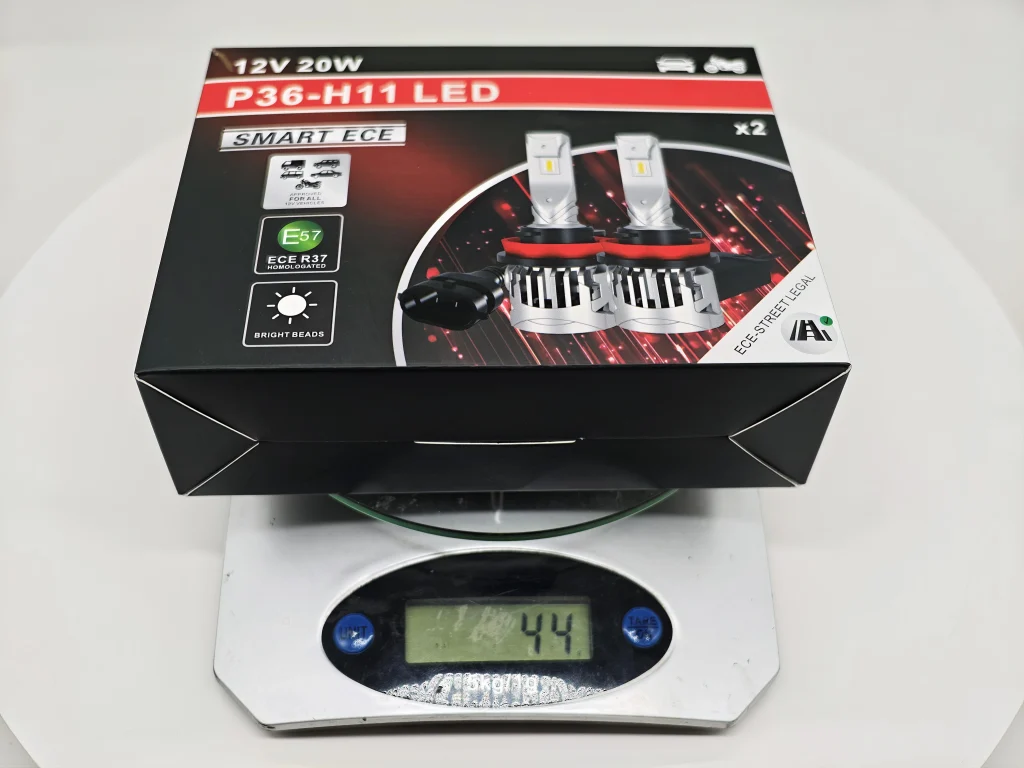
The empty packages weigh 51 g for EB and 44 g for Luxfighter. Luxfighter is 7 g lighter per box; the smaller EB package does not also have the lower packaging weight.
| Item | EB | Luxfighter | Difference |
|---|---|---|---|
| External dimensions | 118 × 55 × 120 mm | 155 × 51 × 123 mm | EB is shorter and slightly lower; Luxfighter is narrower. |
| Nominal external volume | 0.779 L | 0.972 L | EB is 19.90% smaller. |
| Empty-package weight | 51 g | 44 g | Luxfighter is 7 g lighter. |
| Presentation | Two plain inner boxes and accessory bag | Foam support, a cable tie and printed instructions | Different internal presentation. |
Conclusion: EB’s 19.90% smaller nominal package volume reduces the space attributable to each box and can help with volume-based freight and storage planning. Luxfighter saves 7 g of empty-package weight per unit. For 100 boxes, the dimensions amount to about 19.35 L less nominal box volume for EB, while Luxfighter adds 0.7 kg less empty-packaging weight. Actual freight savings depend on the shipping carton and carrier’s pricing method.
2. Lamp Construction Comparison
Both samples have an H11 connector, a keyed mounting base, a red sealing ring, rear cooling fins and an external driver. The retaining-spring detail is an important difference in this pair.
Lamp and external-driver overview
The images show the connector face used by each sample.
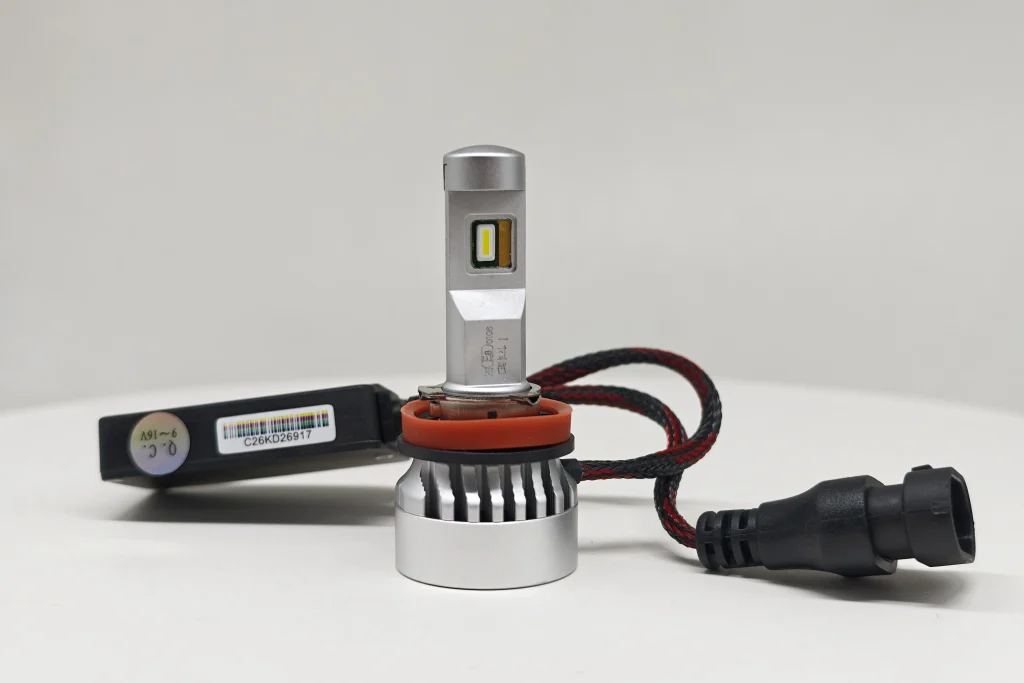
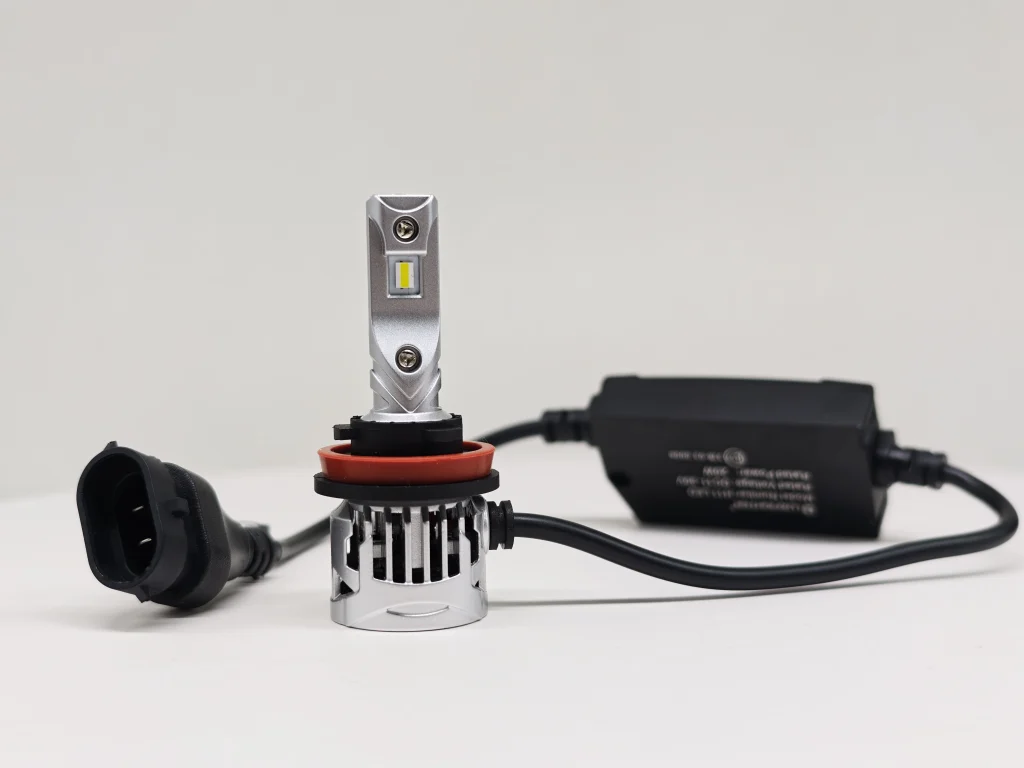
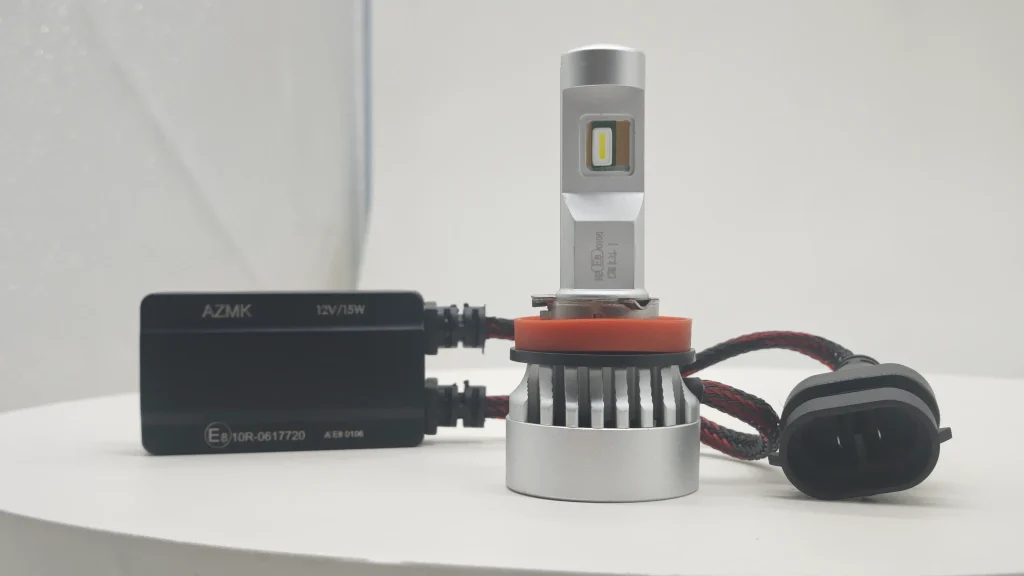
EB uses a cylindrical rear heat sink with braided leads and a flat rectangular driver housing. Luxfighter uses an open, slotted rear cooling assembly, smooth black leads and a separate moulded driver housing. Both place the driver outside the emitter blade, so the lamp, cables and driver all form part of the assembly dimensions.
H11 Connector Interface
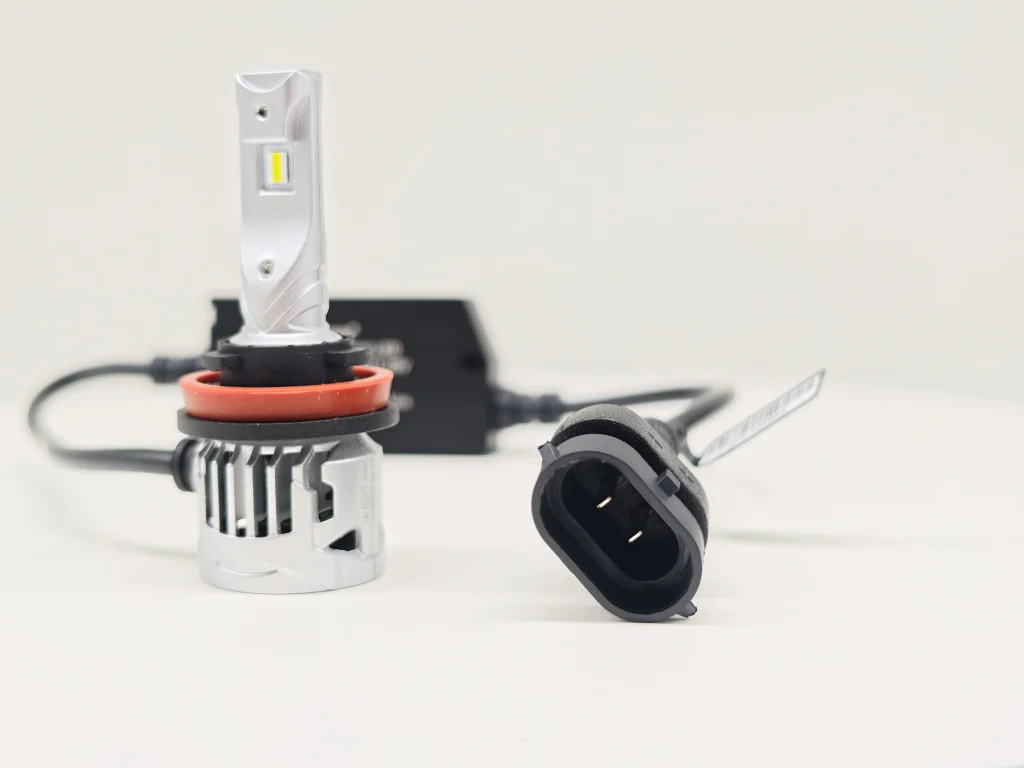
Both samples show an oval, keyed two-pin H11 connector with a central divider.
PGJ19-2 base and locating features
The top views show the PGJ19-2 mounting structure of each sample.
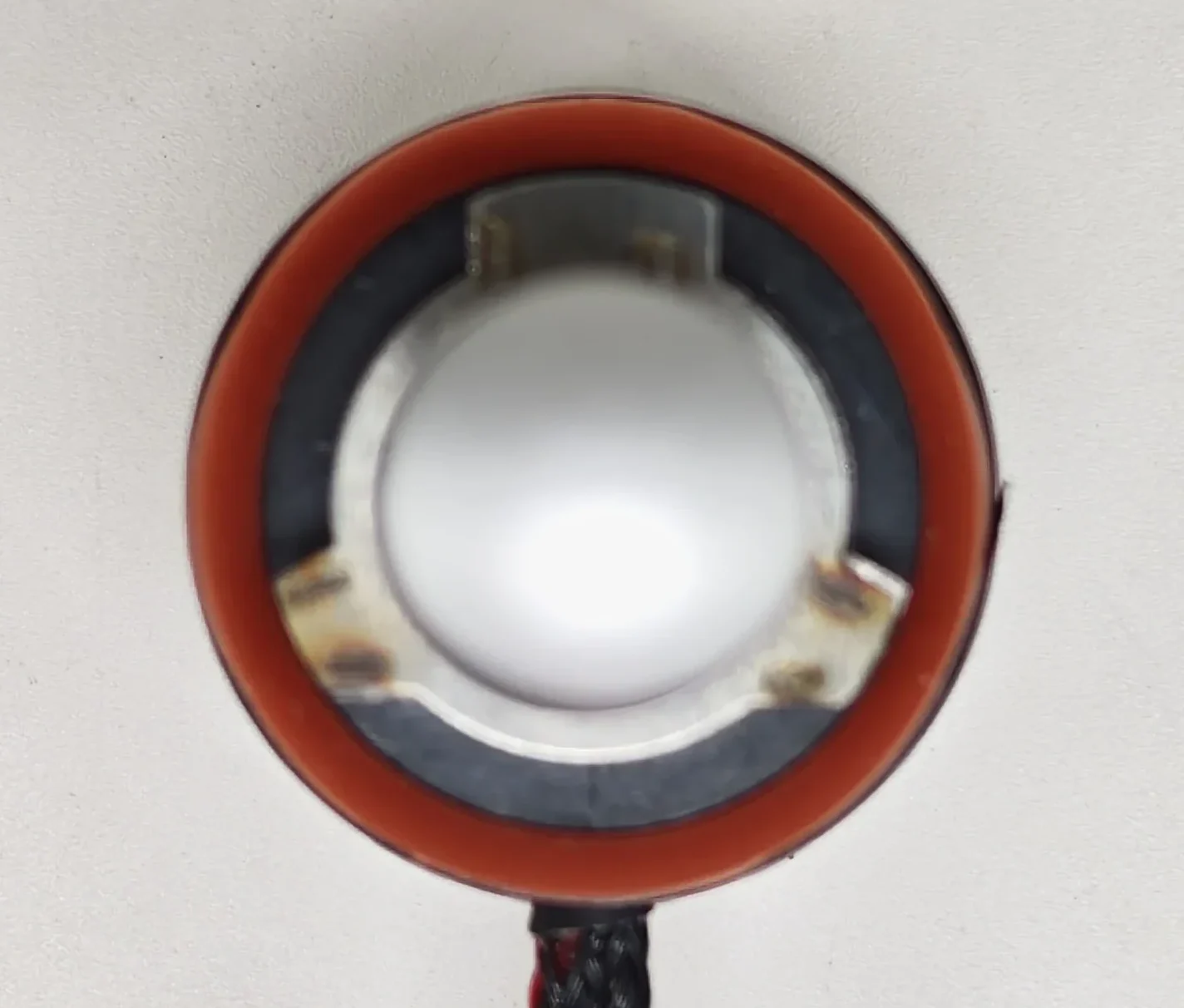
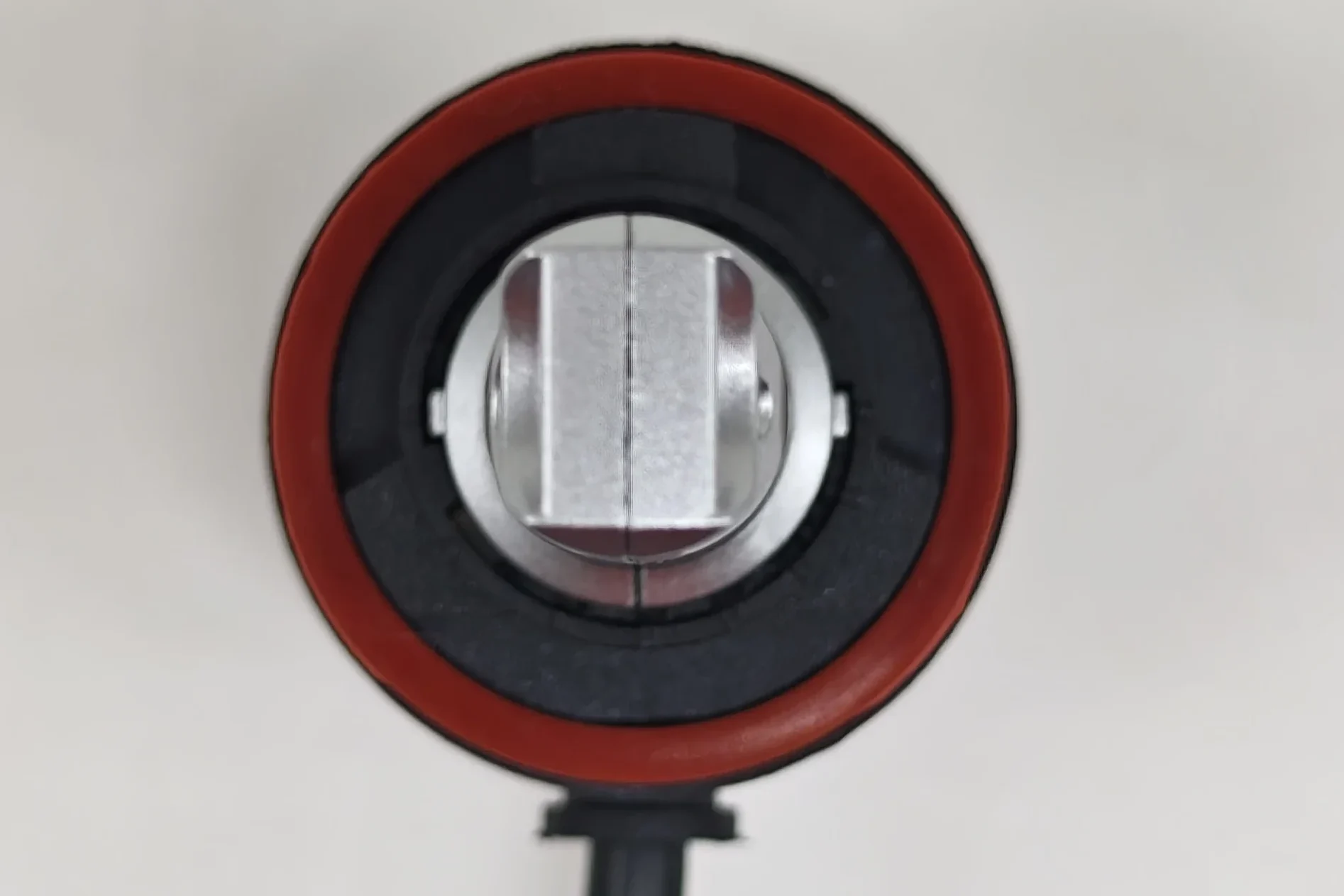
EB’s top view shows metal locating features around the blade. Luxfighter has a black keyed mounting collar. Both use a red sealing ring.
Base installation-section measurement
| Why Measure Pillar Thickness | Main Impact | Relevance to Actual Headlight Performance |
|---|---|---|
| Light obstruction | The pillar can block part of the light emitted sideways or at oblique angles from the LED | An excessively thick pillar may block certain emission angles, resulting in incomplete angular light distribution or local dark areas |
| Heat transfer | The pillar is also part of the main thermal path from the LED chip to the heat sink | Its cross-section, material and internal structure affect how efficiently heat is transferred, influencing junction temperature and sustained light output |
| Structural strength and stability | The pillar provides mechanical support for the LED chip, PCB or substrate | An excessively thin pillar may reduce rigidity and increase the risk of displacement or deformation during assembly, vibration or thermal cycling |
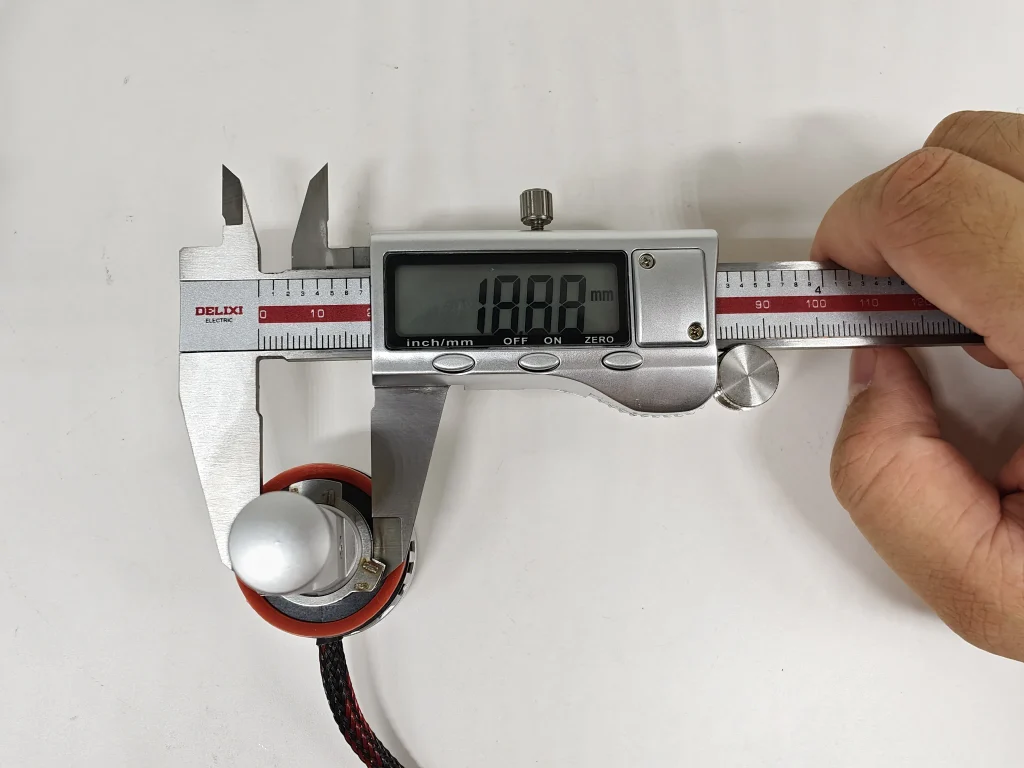
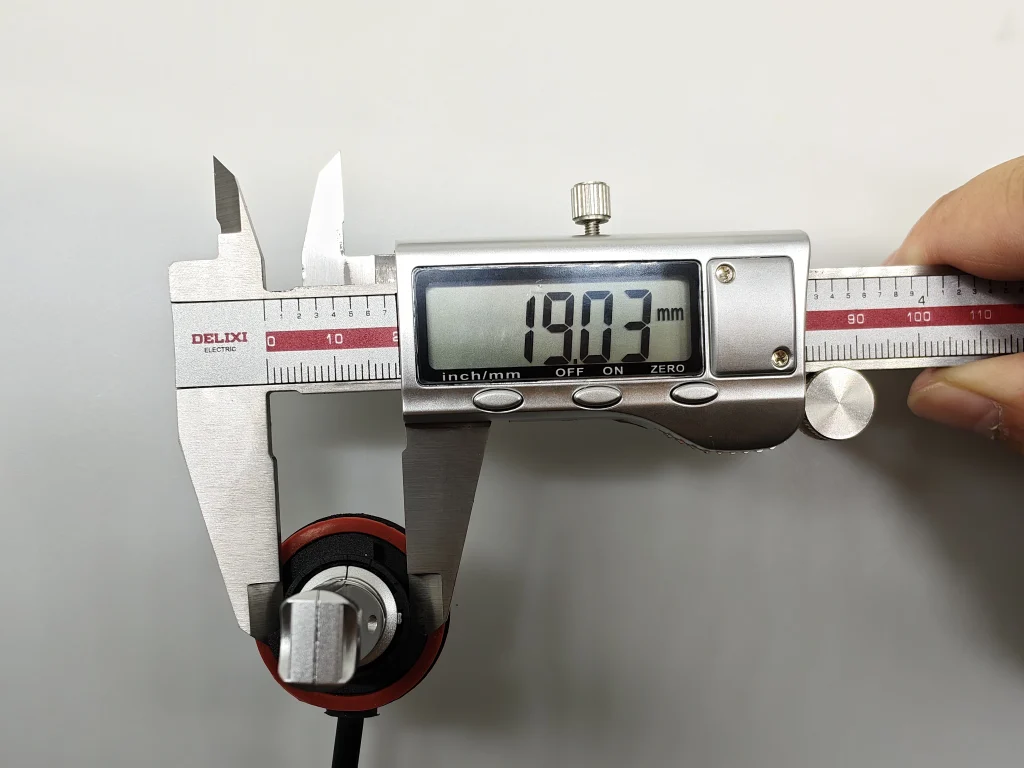
In terms of installation dimensions, these two products are very similar. The EB is slightly smaller, but the difference is minimal. Based on this measurement alone, it is not possible to conclude that either product has a clear advantage in terms of installation compatibility, structural strength, or optical performance.
Metal retaining spring
A retaining spring provides elastic preload at the mounting interface. This makes spring retention a separate feature to check when comparing bases with a similar keyed shape.
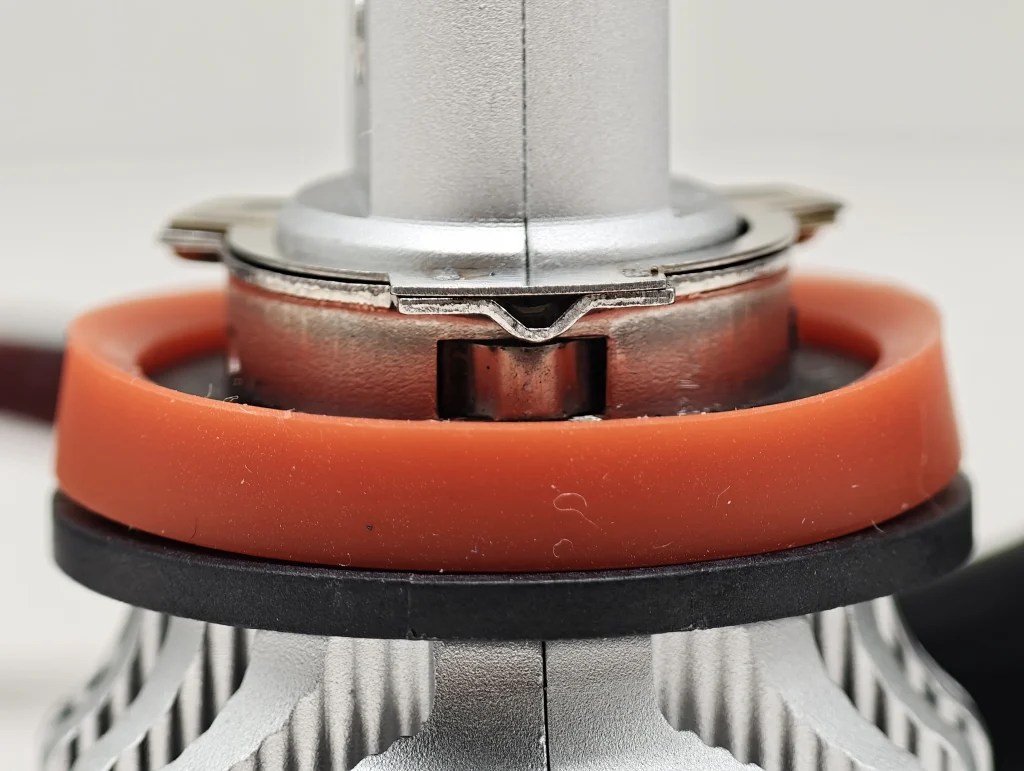
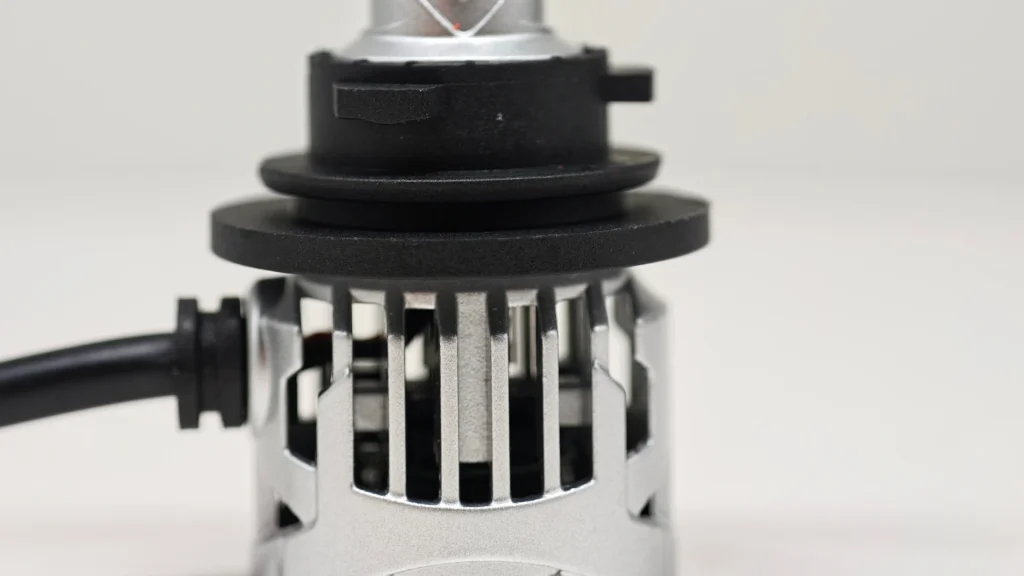
EB has a separate metal retaining spring beneath the flange. The Luxfighter close-up shows the black mounting collar above the cooling assembly, with no separate metal retaining spring visible.
| Item | EB | Luxfighter | Comparison |
|---|---|---|---|
| Installation-section diameter | 18.88 mm | 19.03 mm | EB is 0.15 mm smaller. |
| Locating structure | Metal locating features | Black keyed collar | Different mounting construction. |
| Rear cooling assembly | Cylindrical heat sink and fan | Open slotted heat sink and fan | Different rear geometry. |
| Cable | Braided outer covering | Smooth black outer covering | Different lead construction. |
| External driver | Flat rectangular housing | Separate moulded housing | Both use an external module. |
| Metal retaining spring | Present | The structure was not found. | EB includes a separate spring-retention feature. |
The main installation difference is the retention design. EB uses a separate metal retaining spring to secure the bulb, while no separate spring is visible on the Luxfighter sample. The installation-section diameters are very close—18.88 mm for EB and 19.03 mm for Luxfighter—so the 0.15 mm difference is minor. Overall, the two products mainly differ in their mounting structure rather than installation diameter.
3. LED Emitting Structure and Box System
The close-ups and micrometer readings compare the emitting geometry. The Box-system images then show where that emitting area sits in the reference frame. The criteria below follow the H11 LEDr category sheets associated with UN Regulation No. 37; see the UNECE H11 LEDr Configuration-2 reference.
LED emitting-surface close-up
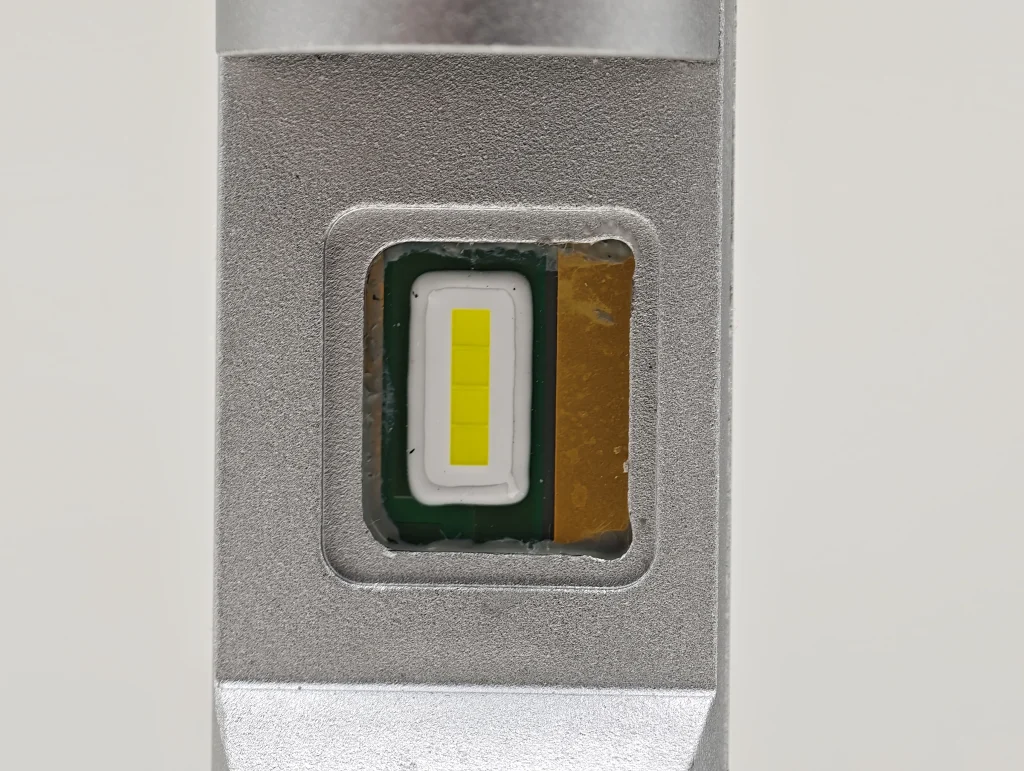
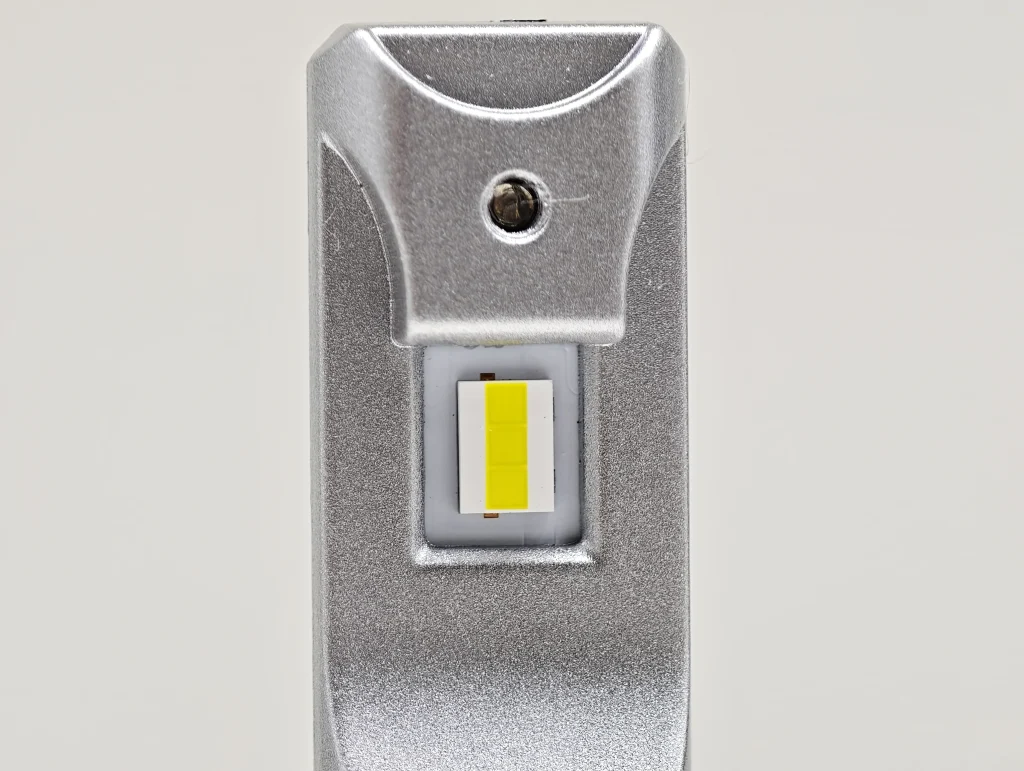
Both products use a rectangular phosphor emitting area, but the internal structure is visibly different. EB shows four distinct emitting segments, while Luxfighter shows three. EB’s emitting area sits within a larger recessed window, whereas Luxfighter uses a narrower white rectangular package mounted inside the metal blade opening.
Distance between opposing LED emitting surfaces
The distance between the two opposing LED emitting surfaces affects how compact the light source is. A thinner emitting structure can help the LED better match the focal geometry of a headlamp originally designed for a filament bulb, which may improve beam control.
For LED emitting surfaces, the UNECE Official specification defines this distance as parameter z and requires it to be no more than 2.9 mm.
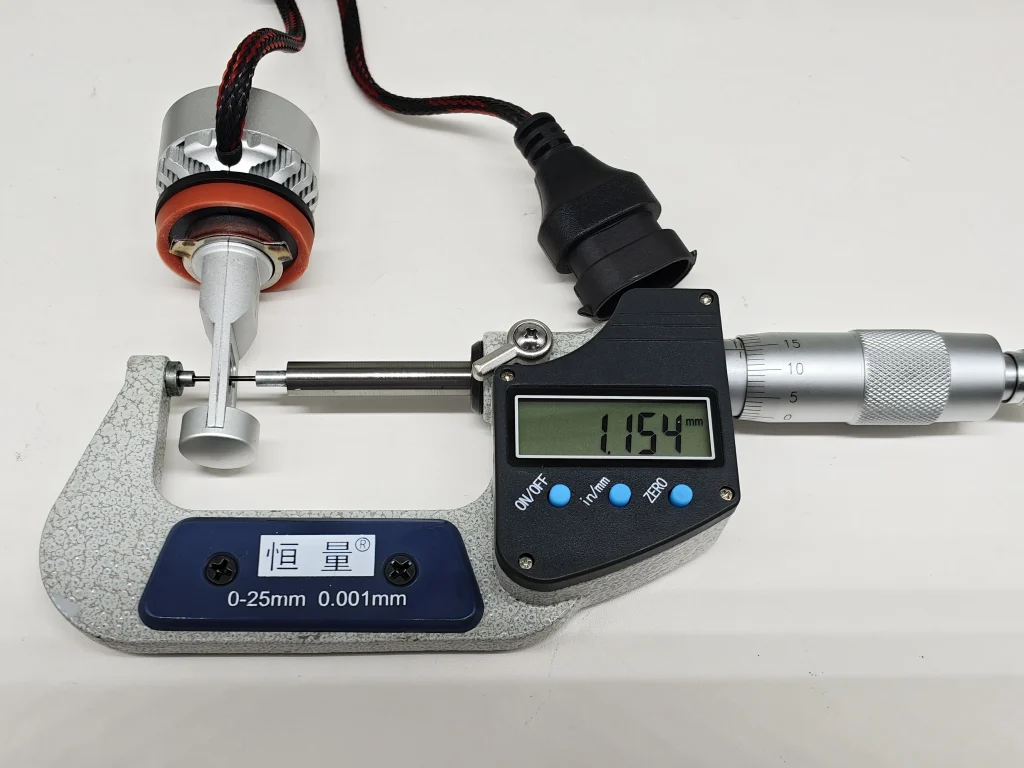
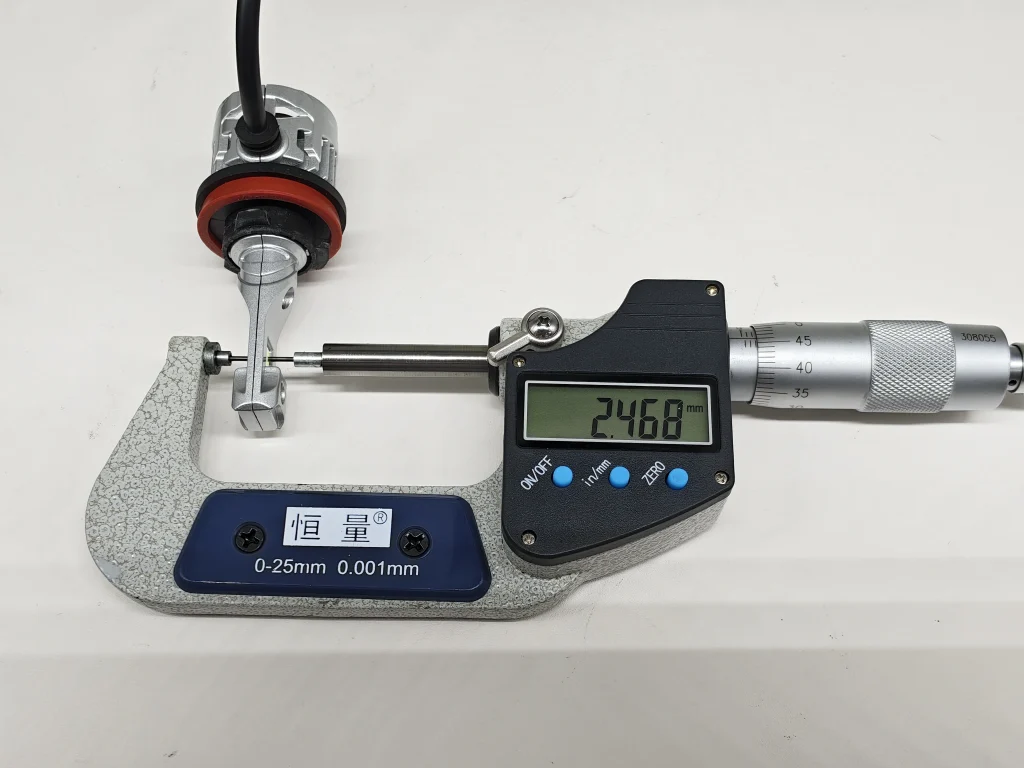
EB measures 1.154 mm and Luxfighter 2.468 mm. EB is 1.314 mm thinner, or 53.24% lower than Luxfighter. Both measurements fall below the 2.9 mm dimensional reference. EB therefore has the thinner measured dual-sided geometry.
Box system
The table below summarizes the luminous-flux requirements for each area in the H11 LEDr Box System and explains how they relate to actual beam performance. The main objective is to keep most of the light concentrated in Area B and B1/B2/B3, while limiting excessive light in Areas A and C and unwanted emission in Area D. This helps maintain the intended emitting position, support a controlled beam pattern, and reduce stray light and glare.
| Area | UNECE Requirement | What the Area Represents | Why It Matters to Beam Performance |
|---|---|---|---|
| A+B+C | ≥ 90% of total luminous flux E | The main effective light-emitting region | Too much light outside A+B+C indicates poor light concentration and can produce more stray light in the projected beam. |
| Area A | ≤ 10% of A+B+C | One side of the core emitting region | Excessive light in Area A shifts the luminous distribution away from the core region and can move the hotspot or alter the beam distribution. |
| Area B | ≥ 72% of A+B+C | The core light-emitting region | Insufficient light in Area B means less luminous flux is concentrated in the core region, which can reduce beam focus and optical control. |
| B1,B2,B3 | Each ≥ 15% of Area B | Three sections that define the distribution within the core B region | Insufficient light in any section makes the core emission less uniform and can affect beam uniformity, hotspot position and cutoff formation. |
| Area C | ≤ 22% of A+B+C | The opposite side of the core emitting region | Excessive light in Area C shifts the luminous distribution away from the core region and can alter the hotspot or projected beam distribution. |
| Area D | Required contrast between A+B+C and D | The glare-control region outside the main emitting area | Visible light or light spots in Area D indicate unwanted emission outside the intended light-emitting region and can lead to glare. |
Box system reference-frame check
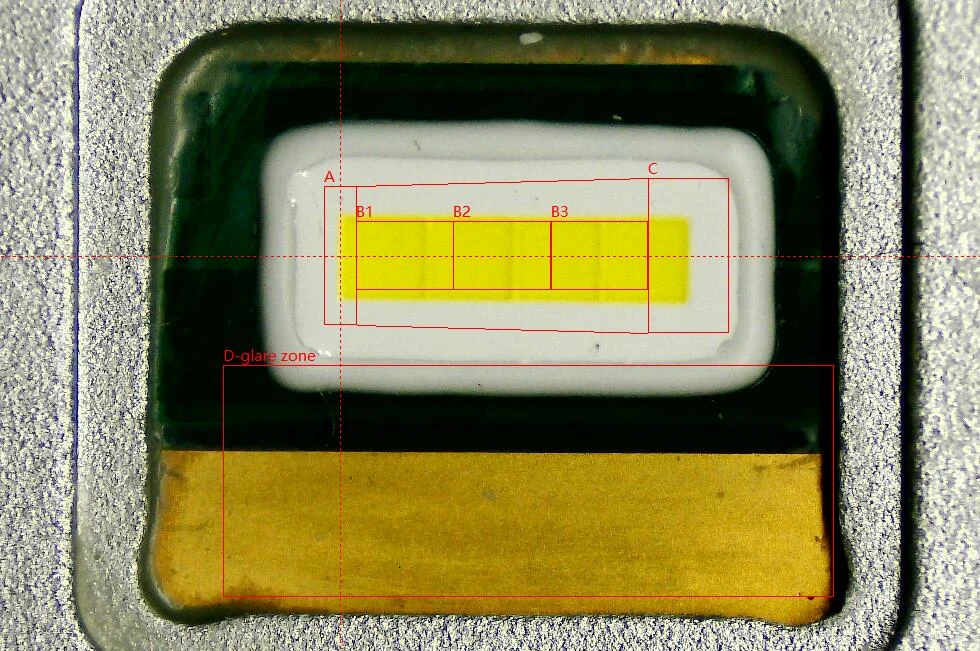
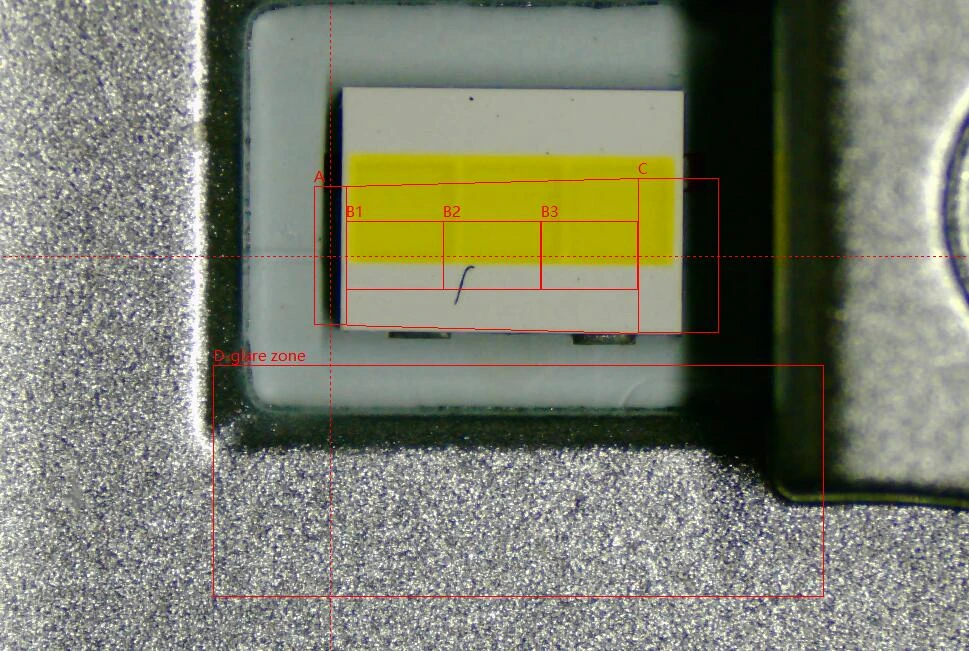
Box system with the emitting area illuminated
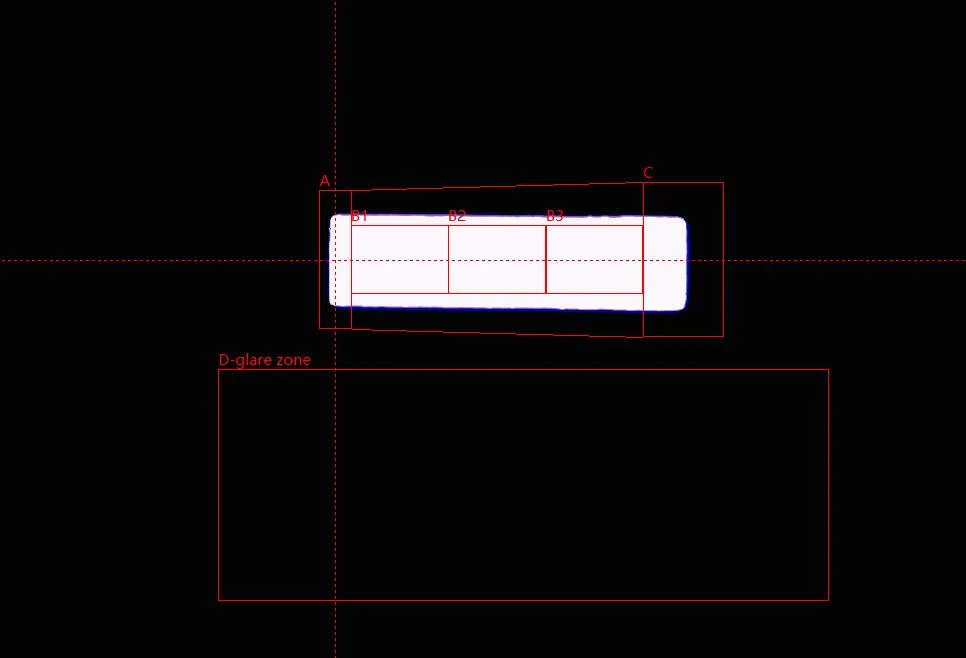
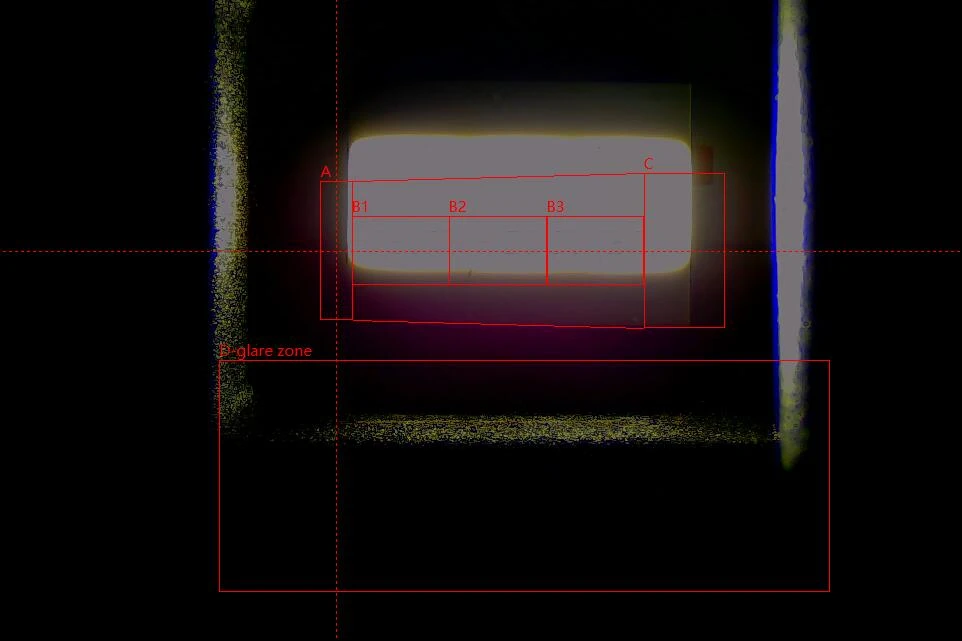
Box system with the emitting area illuminated:EB shows a continuous rectangular emitting band spanning B1, B2 and B3, with the active area sitting well within the core B region. Luxfighter also covers all three sections, but its emitting area is positioned noticeably higher, leaving less coverage in the lower part of B.
Box system with the emitting area illuminated: Once illuminated, EB keeps the bright band compact and the area below it mostly dark.Luxfighter shows more light outside the main emitting area. A long horizontal light band extends through much of Area D, accompanied by a strong vertical bright line on the right and additional diffuse glow below the main band.
| Area | What This Area Tells Us | EB Observation | Luxfighter Observation |
|---|---|---|---|
| A+B+C | Shows whether the main light output stays within the intended emitting region | Main emission remains concentrated within the reference area | Main emission remains within the reference area but sits higher |
| Area A | Limits light on one side of the core B region; excessive light can shift the effective emitting position | Limited emission extends into A | Limited visible emission in A |
| Area B | The core region where most useful light should be concentrated | Main emitting band sits more fully within B | Emitting band is concentrated toward the upper part of B |
| B1 / B2 / B3 | Checks whether the core emitting area is distributed across all three sections | One continuous band covers B1–B3 | All three sections are covered, but the band sits higher |
| Area C | Limits light on the opposite side of B; excessive light can shift the emitting position | Some emission extends toward C | Emission also approaches the C side |
| Area D | Shows unwanted emission outside the main emitting area; visible light here can contribute to glare | Area D remains largely dark | A long horizontal light band, a strong vertical bright line, and diffuse emission are visible in Area D |
Box System Comparison
EB keeps its main emitting band better aligned with the core B region, while Luxfighter’s emitting area sits higher.
The more significant difference is in Area D. EB keeps this region largely dark, whereas Luxfighter shows a continuous horizontal light band together with additional bright and diffuse emission.
Overall, EB shows more accurate B-region positioning and cleaner control of stray emission, while Luxfighter shows a higher emitting position and substantially more unwanted light in Area D.
4. Beam Pattern and Illuminance Comparison
White-wall photographs show the cutoff and bright-area shape. Rainbow maps make the visible distribution easier to compare, while the nine-point measurements quantify the differences.
White-wall beam pattern
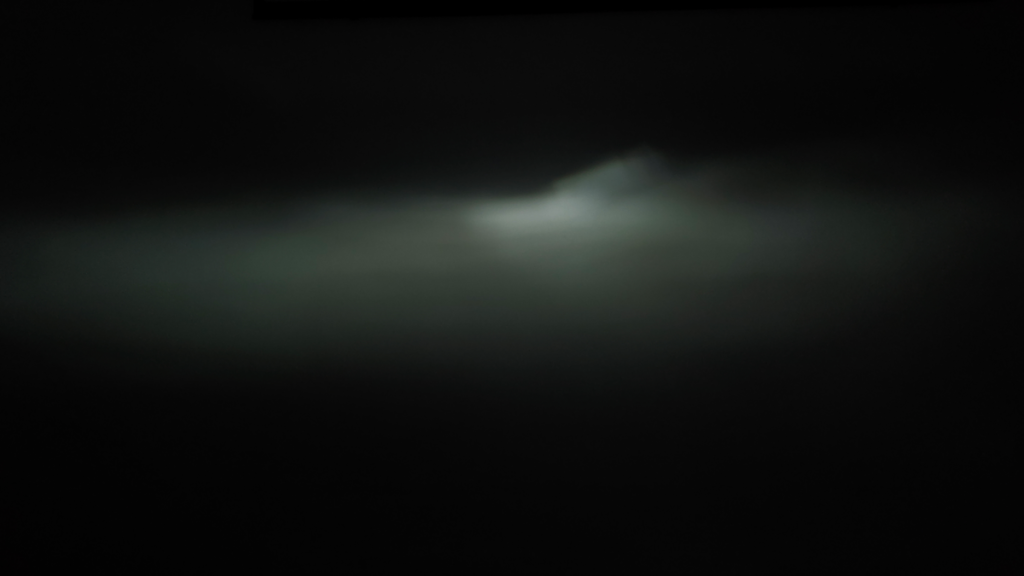
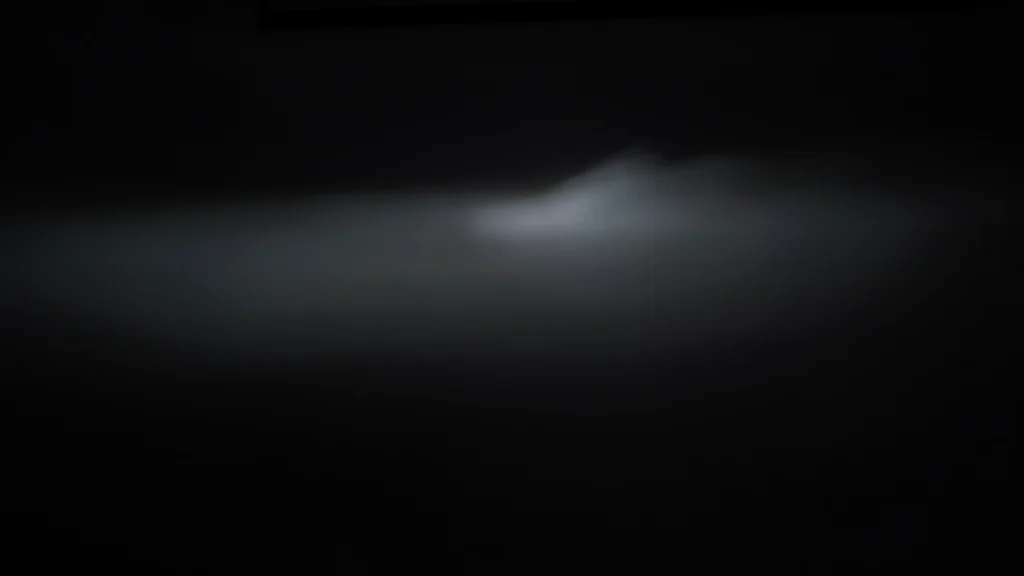
Beam Pattern Observation
Both products form a clear low-beam pattern, but Luxfighter’s hotspot sits closer to the rising cutoff and shows more light spreading around the upper transition area. EB keeps the hotspot lower and the surrounding light distribution more even.
What Causes the Difference?
The test described above helps explain this. Luxfighter’s emitting area sits higher in the Box System, which can shift more light toward the upper cutoff region. Its larger opposing emitting-surface distance (2.468 mm vs 1.154 mm for EB) also creates a thicker effective light source, making the projected light less compact. In addition, the stronger emission seen in Area D can contribute to extra stray light around the cutoff.
Overall Comparison
EB’s more centered emitting position, thinner emitting geometry, and cleaner Area D control correspond with a more controlled low-beam pattern, while Luxfighter shows a higher hotspot and more light spread around the cutoff.
Rainbow map and hotspot distribution
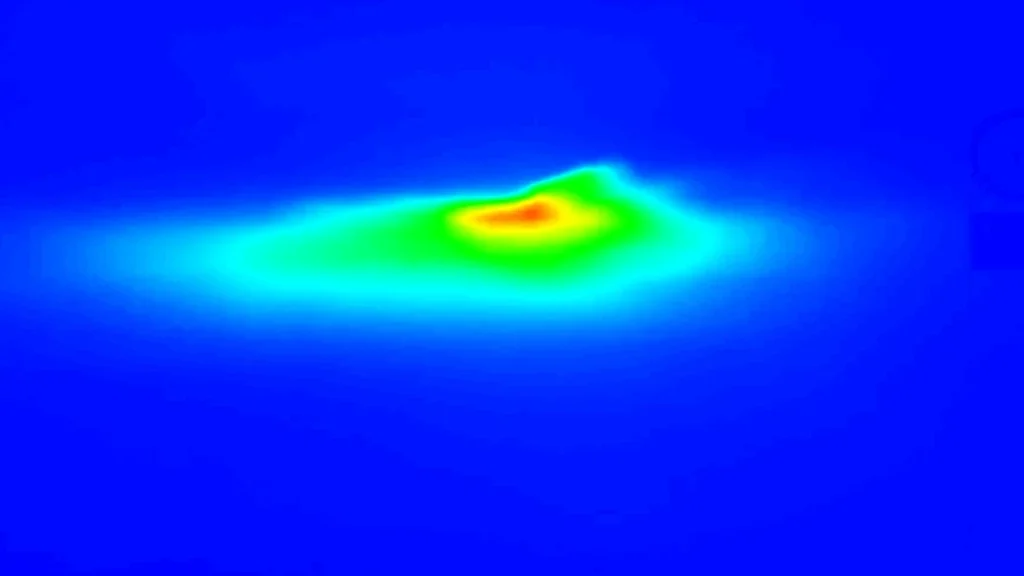
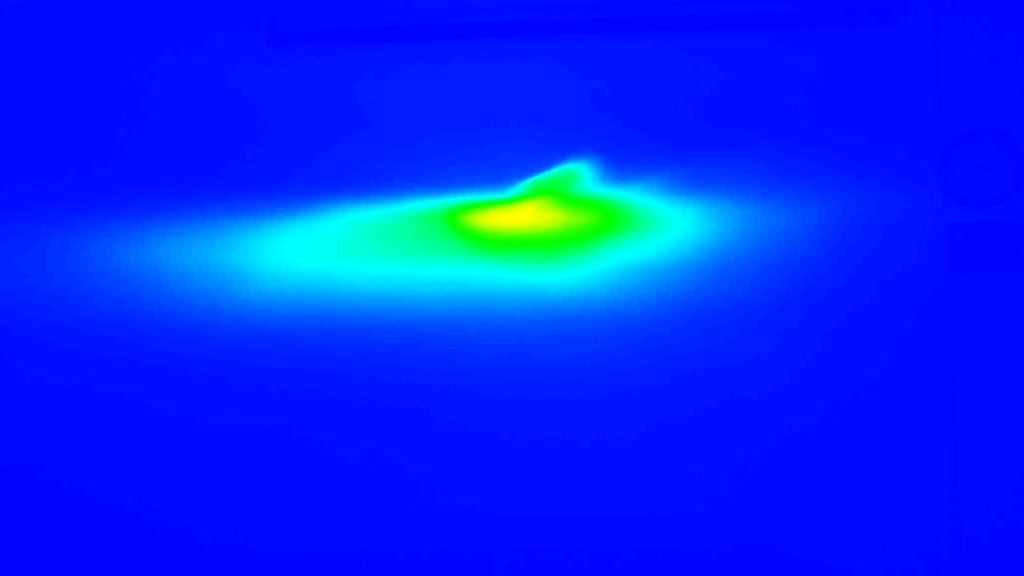
The rainbow maps show that EB concentrates more of its high-illuminance energy into a compact red/orange hotspot, with a relatively tight transition into the surrounding yellow-green area. Luxfighter shows a broader high-energy region, with more of the light extending upward and to the right. This difference is consistent with the earlier structural observations: EB has a smaller opposing emitting-surface distance (1.154 mm vs 2.468 mm) and a more centrally positioned emitting area within the B region. Together with the light source’s angular intensity distribution, these factors affect how efficiently the headlamp optics collect and concentrate the emitted light. As a result, EB produces a more concentrated hotspot, while Luxfighter spreads the high-illuminance energy over a wider area.
Nine-point illuminance with B50L focus
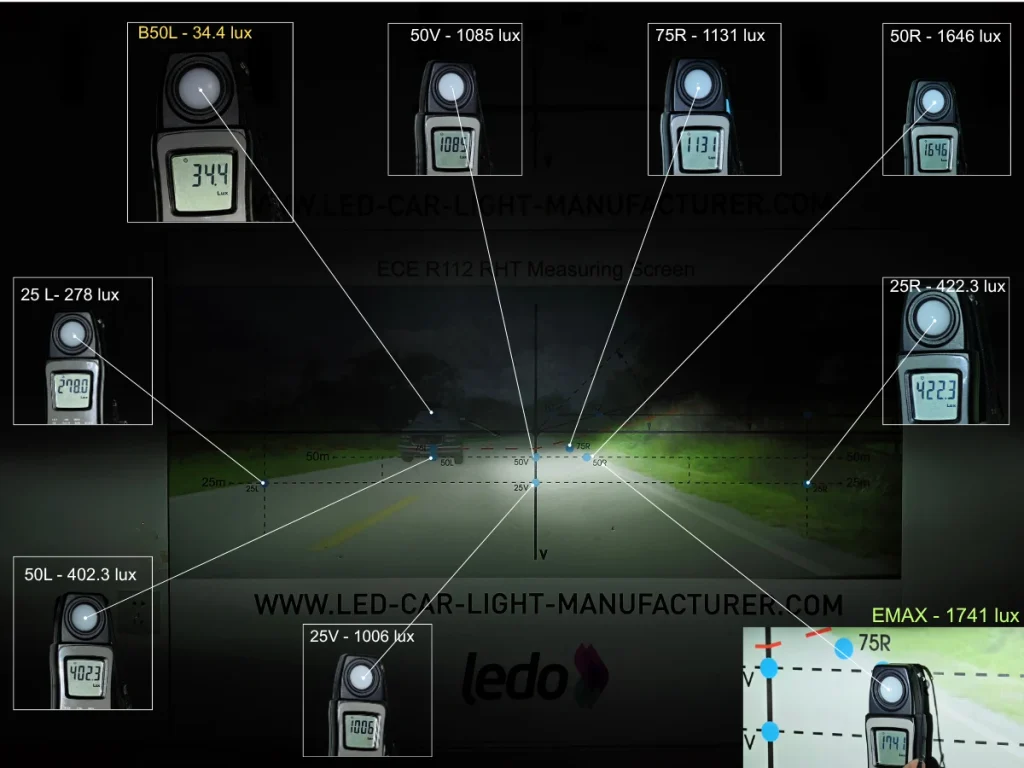
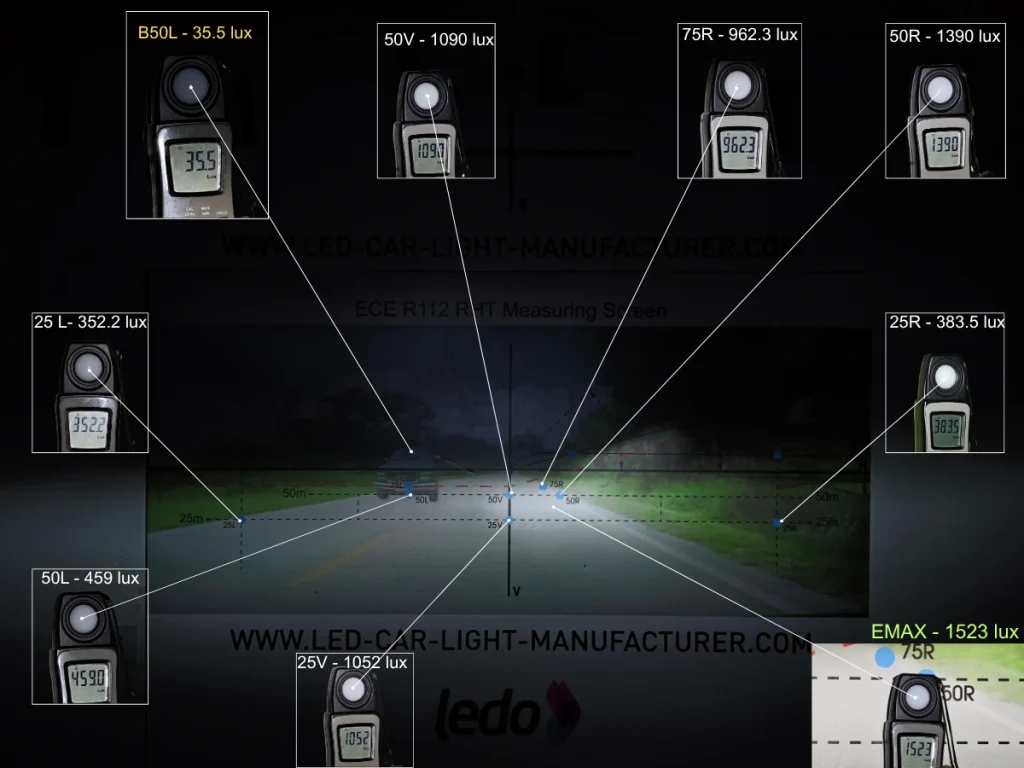
EB reaches 1,741 lux at EMAX, 218 lux above Luxfighter. At B50L, EB records 34.4 lux versus Luxfighter’s 35.5 lux. EB therefore combines a higher recorded peak with slightly less light at this specific glare-control point.
| Point or group | Measurement purpose | Interpretation |
|---|---|---|
| B50L | Glare-control point above and left of the cutoff | Lower illuminance means less light at this point. |
| 50L | Controlled left-side distribution below the cutoff | Assess against the applicable upper and lower limits. |
| 25L | Left-side illumination | Higher means more light at this point; it is not B50L. |
| 50V / 25V | Central distribution | Shows the light placed at the central reference points. |
| 75R / 50R / 25R | Right-side distribution | Shows light at the three right-side reference points. |
| EMAX | Peak illuminance | Records the highest measured illuminance. |
| Point | EB (lux) | Luxfighter (lux) | EB − Luxfighter (lux) | EB relative to Luxfighter | Comparison |
|---|---|---|---|---|---|
| B50L | 34.4 | 35.5 | −1.1 | −3.10% | EB records 1.1 lux less at the glare-control point. |
| 25L | 278 | 352.2 | −74.2 | −21.07% | Luxfighter is higher at this left-side point. |
| 50L | 402.3 | 459 | −56.7 | −12.35% | Luxfighter is higher; applicable limits govern interpretation. |
| 50V | 1,085 | 1,090 | −5 | −0.46% | The central readings differ by 5 lux. |
| 25V | 1,006 | 1,052 | −46 | −4.37% | Luxfighter is higher at this central point. |
| 75R | 1,131 | 962.3 | +168.7 | +17.53% | EB is higher at the right-side point. |
| 50R | 1,646 | 1,390 | +256 | +18.42% | EB is higher at the right-side point. |
| 25R | 422.3 | 383.5 | +38.8 | +10.12% | EB is higher at the right-side point. |
| EMAX | 1,741 | 1,523 | +218 | +14.31% | EB records the higher peak illuminance. |
EB records 14.31% higher EMAX and higher illuminance at 25R, 50R and 75R. Its B50L reading is also lower, although the gap is small at 1.1 lux: 34.4 versus 35.5 lux. Luxfighter is higher through the centre-left, with 50V nearly level at 1,090 versus 1,085 lux. EB’s measured optical advantage is higher right-side and peak output without a higher B50L reading in this setup. These 3.5 m results compare sample distribution, not type-approval compliance.
5. Temperature and Fan Noise
Surface temperature was recorded after 30 minutes. Fan noise was measured separately at 3.5 cm.
Emitting-Area Surface Temperature After 30 Minutes
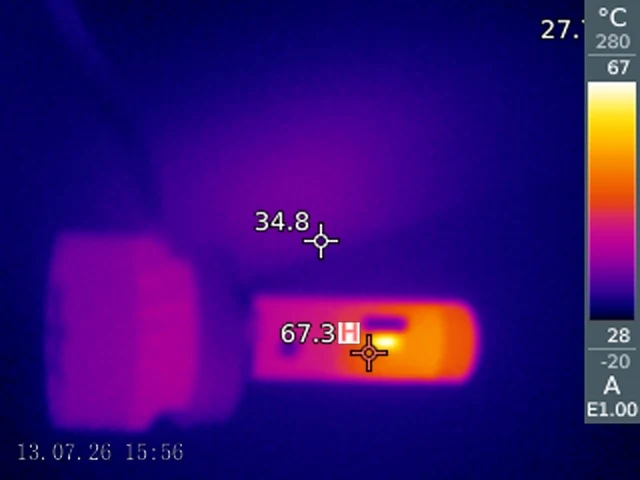
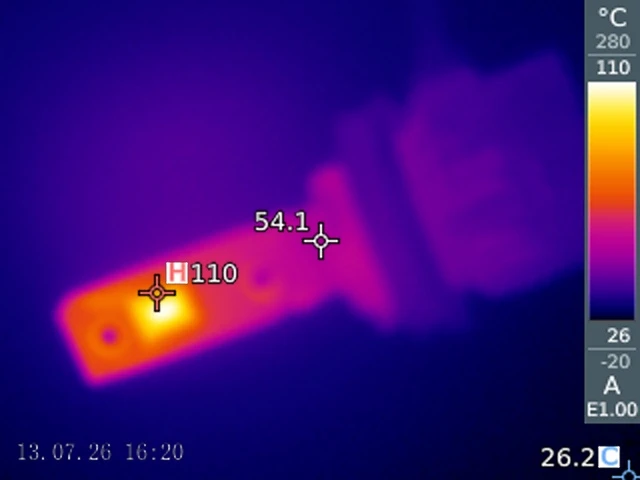
EB records 67.3°C at the LED emitting section, compared with 110°C for Luxfighter, a difference of 42.7°C. With similar surrounding temperatures, EB shows significantly lower local heat accumulation under the same test conditions.
These are surface temperatures, not LED junction temperatures.
Operating noise at 3.5 cm from the fan
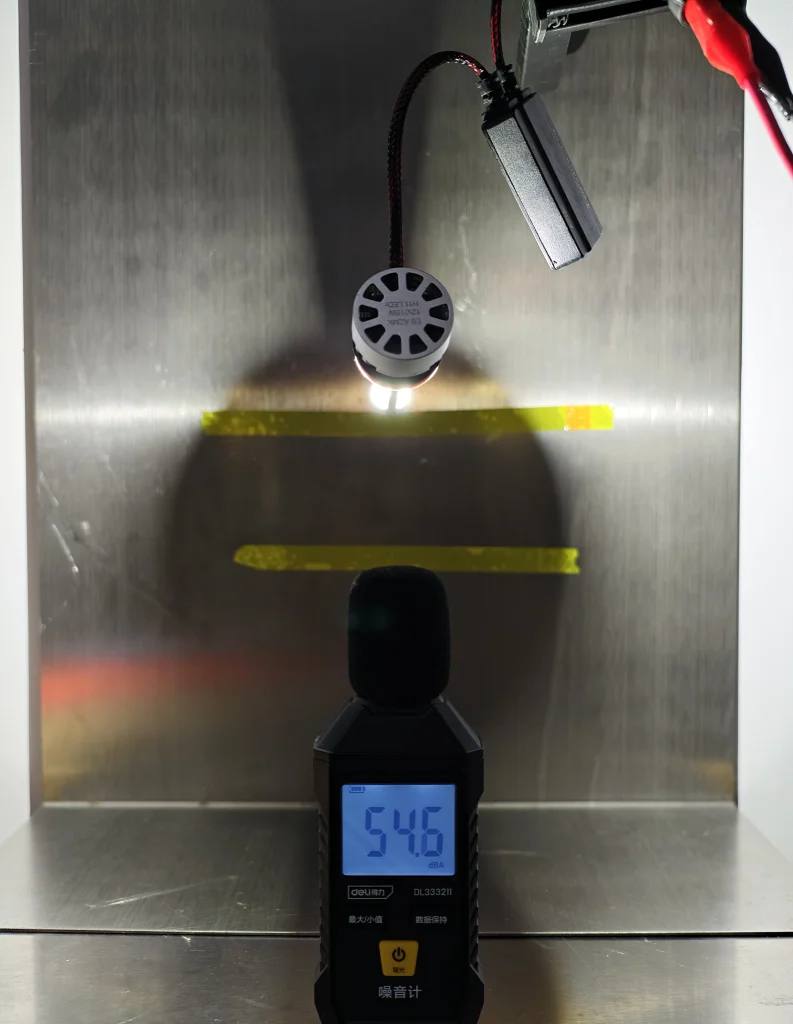
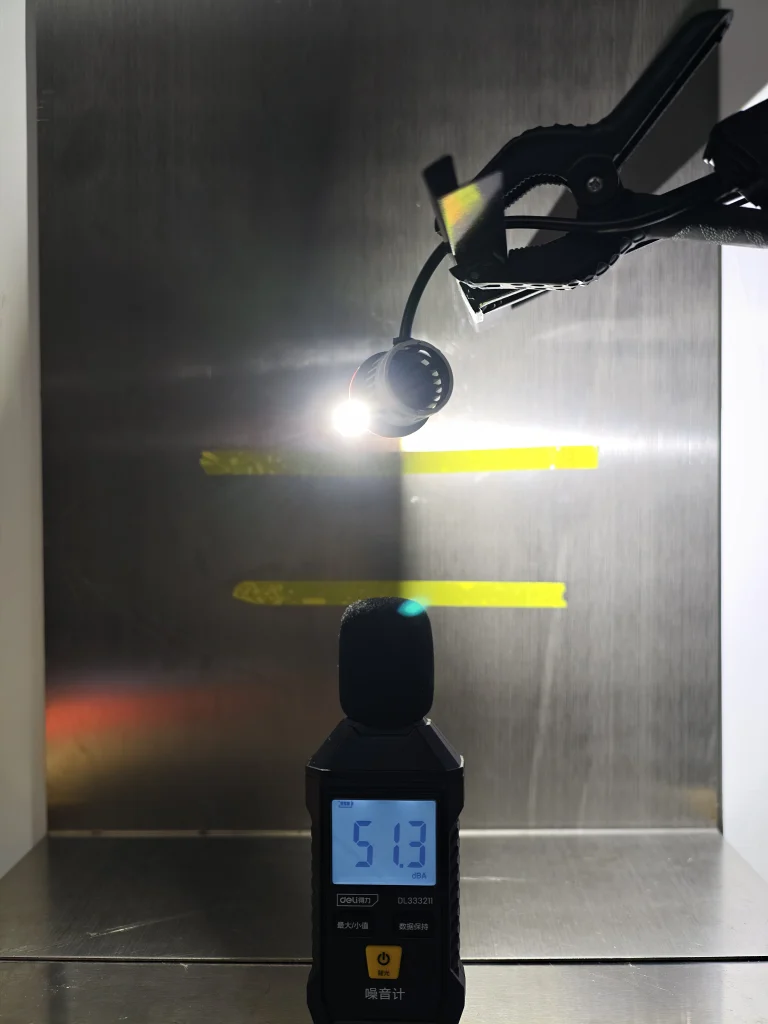
EB measures 54.6 dBA and Luxfighter 51.3 dBA. Luxfighter is 3.3 dBA lower in this close-range fan-noise test.
| Metric | Condition | EB | Luxfighter | Result |
|---|---|---|---|---|
| Emitting-area surface temperature | 13.2 V, 26°C, 30 minutes | 67.3°C | 110°C | EB is 42.7°C lower. |
| Fan noise | 3.5 cm from the fan | 54.6 dBA | 51.3 dBA | Luxfighter is 3.3 dBA lower. |
After 30 minutes, EB’s emitting-area surface is 42.7°C cooler. Luxfighter records 3.3 dBA less fan noise at 3.5 cm.
6. What This Comparison Means for Customers
- Packaging: EB’s nominal external volume is 19.90% smaller, which can help reduce bulk-storage and volume-based shipping space. Luxfighter’s empty package is 7 g lighter,it can also help save costs when freight charges are calculated by weight.
- Lamp construction: EB includes a separate metal retaining spring. No equivalent spring is visible on the reviewed Luxfighter base, making retention a specific feature to include in the purchase specification.
- Emitting structure: EB measures 1.154 mm between opposing emitting surfaces versus 2.468 mm for Luxfighter. Its illuminated band also fits the marked B region more closely and keeps D dark.
- Beam and illuminance: EB combines 14.31% higher peak illuminance with higher 25R, 50R and 75R readings. B50L is slightly lower at 34.4 lux versus 35.5 lux. Luxfighter places more measured light through the centre-left.
- Temperature and noise: EB’s measured surface temperature is 42.7°C lower after 30 minutes, while Luxfighter’s fan noise is 3.3 dBA lower at 3.5 cm.
Overall: EB offers the smaller package, a visible spring-retention feature, thinner measured emitting geometry, closer Box-frame alignment, higher right-side and peak illuminance, and lower measured surface temperature. Those are the concrete reasons to consider EB when these features match the product specification.
EB vs Luxfighter H11 LEDr FAQ
Were the lamps tested under the same conditions?
Both records use 13.2 V and a 26°C environment. Illuminance was measured at 3.5 m after a 30-minute warm-up, emitting-area surface temperature at 30 minutes, and fan noise at 3.5 cm.
Do both samples have a metal retaining spring?
A separate metal retaining spring is visible on EB. The recorded Luxfighter base detail shows no separate metal retaining spring.
What does the 1.154 mm versus 2.468 mm measurement describe?
It is the distance between opposing LED emitting surfaces. EB is 1.314 mm thinner, or 53.24% lower than Luxfighter.
Which sample records less light at B50L?
EB records 34.4 lux and Luxfighter 35.5 lux. The EB reading is 1.1 lux lower at this glare-control point, while its EMAX is 218 lux higher.
Which sample is quieter?
Luxfighter records 51.3 dBA versus EB’s 54.6 dBA at 3.5 cm from the fan, a 3.3 dBA difference.
Prepared by LEDOAUTO, the manufacturer of EB. Article contact: Jack Liu, Co-founder & Product Director.
Preview updated: 3 September 2026.